Retail & Shopping Center
Parking Lighting Guide
IES RP-20 enhanced security standards for malls, grocery stores, and shopping plazas
56%
Energy Savings
2–5 fc
IES RP-20 Target
Free
Photometric Design
IES RP-20 Retail Parking Illuminance Standards
Recommended foot-candle levels for retail and shopping facility parking areas
General parking — enhanced security
Standard for active retail lots
Entrances & exits
High-traffic ingress/egress zones
Pedestrian crosswalks
ADA accessible paths required
ADA accessible spaces
ADA Title II & III compliance
Fire lane & emergency access
Required for fire code
Cart return & bike parking
Safety and theft deterrence
Building perimeter (security)
Camera coverage zone
Source: IES RP-20 (Lighting for Parking Facilities). Always verify with local AHJ — municipal codes may impose stricter requirements.
💡Security camera effectiveness requires CRI ≥ 70. All Auvolar LED area lights exceed this threshold. Retailers with IP cameras report significantly clearer footage with 5000K LED vs. sodium vapor or old metal halide lamps.
Pole Height, Spacing & Wattage Selection Guide
Match mounting height to lot size and required illuminance
20–25 ft
25–30 ft
30–35 ft
35–40 ft
Light Distribution Guide: Type III vs Type V
Choosing the right optic pattern for retail parking applications
Type III — Perimeter Poles
Asymmetric forward throw. Points light inward from lot edge — no trespass onto neighboring properties or streets.
Type V — Interior Poles
Symmetric circular distribution — equal light in all directions. Best for center-of-lot poles surrounded by parking on all sides.
Compliance & Special Requirements
Key regulations for retail parking lot lighting design
IES RP-20 Enhanced Security
2.0–5.0 fc average, 3:1 uniformity
Required for retail and shopping facilities
ADA Title II & III
Minimum 2.0 fc at accessible spaces, no dark spots
Federal requirement for all public facilities
Full cutoff optics
Zero light above 90° horizontal
All Auvolar area lights comply ✅
ASHRAE 90.1-2022
Exterior lighting controls: photocell + 50% reduction capability
Required for permitted new construction
Fire code access lanes
Minimum 2.0 fc along designated fire lanes
Local AHJ enforcement varies
Security camera CRI
CRI ≥ 70 for adequate camera color rendering
All Auvolar LED products CRI ≥ 70 ✅
Lighting Solutions by Retail Scenario
Design parameters, example configurations, and recommended products for each retail application
🏬 Regional & Super-Regional Shopping Malls
Regional malls with 500–1,500 spaces face the highest lighting demands in retail. Extended evening hours (often until 10 PM) require consistent 3.0–5.0 fc across the entire lot. Security cameras throughout the property demand CRI ≥ 70 for effective footage. Brand perception is critical — a well-lit lot increases perceived safety and dwell time.
Design Parameters
| Target illuminance | 3.0–5.0 fc (enhanced security) |
| Min illuminance | 1.0 fc |
| Uniformity | 3:1 (avg:min) |
| Pole height | 25–35 ft |
| CCT | 5000K (daylight white for cameras) |
| Controls | Photocell + timer dimming after close |
Example Configuration
Recommended Products


🛒 Supermarket & Grocery Store Parking
Grocery stores are active evening destinations — shopping patterns peak from 5–9 PM when lighting is critical. Cart corrals, crosswalks, and loading dock areas all need separate lighting consideration. Turnover is high so entrance lighting at 3.0–5.0 fc is essential for customer flow and security visibility.
Design Parameters
| Target illuminance | 2.0–4.0 fc avg |
| Entrances | 3.0–5.0 fc |
| Uniformity | 3:1 or better |
| Pole height | 25–30 ft |
| CCT | 5000K or 4000K |
| Controls | Photocell + 50% after-hours dimming |
Example Configuration
Recommended Products

🏪 Strip Mall & Shopping Plaza
Strip malls house diverse tenants with different hours — a gym, restaurant, and nail salon may all share the same lot but have very different closing times. Lighting must cover the full lot until the last tenant closes. Building-mounted wall packs supplement pole lighting along storefronts and provide additional security coverage.
Design Parameters
| Target illuminance | 2.0–3.0 fc avg |
| Min illuminance | 0.5 fc |
| Uniformity | 4:1 or better |
| Pole height | 20–25 ft |
| CCT | 4000K–5000K |
| Controls | Photocell (dusk-to-dawn or timer) |
Example Configuration
Recommended Products

🏗️ Retail Parking Structures & Garages
Covered retail parking garages require significantly higher illuminance than open lots — IES RP-20 calls for 5.0 fc average in general areas and up to 50 fc at garage entrances for adaptation during daylight transitions. Canopy-style fixtures provide even distribution without poles, maximizing clearance for vehicles.
Design Parameters
| General garage area | 5.0 fc avg |
| Entry/exit (daytime) | 25–50 fc (adaptation zone) |
| Min illuminance | 1.0 fc |
| Uniformity | 10:1 max |
| Fixture type | Canopy / direct mount |
| Controls | Photocell + occupancy dimming |
Example Configuration
Recommended Products

🔒 Overnight Security & Perimeter Coverage
After closing, retail lots often become hotspots for loitering and property crime. Overnight security lighting must balance energy savings with deterrence — typically 1.0–2.0 fc at reduced power via 50% dimming controls after store hours. Perimeter poles with Type III optics keep light inward and minimize neighbor complaints.
Design Parameters
| After-hours illuminance | 1.0–2.0 fc avg |
| Uniformity | 4:1 or better |
| Controls | Photocell + timer (50% dim after 11 PM) |
| Pole height | 25–30 ft perimeter |
| Distribution | Type III (inward throw, no trespass) |
| CCT | 5000K (camera effectiveness) |
Example Configuration
Recommended Products
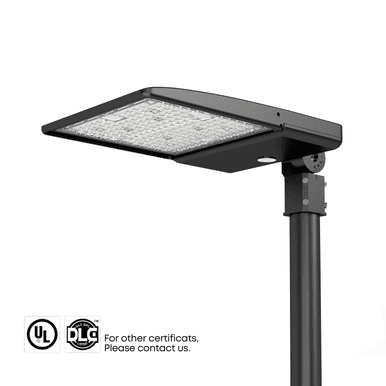
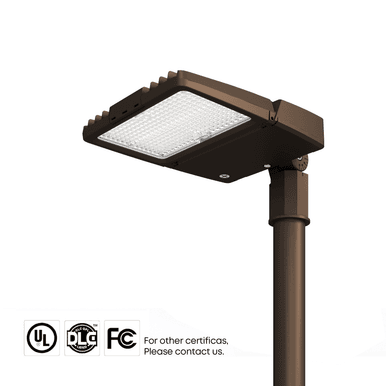
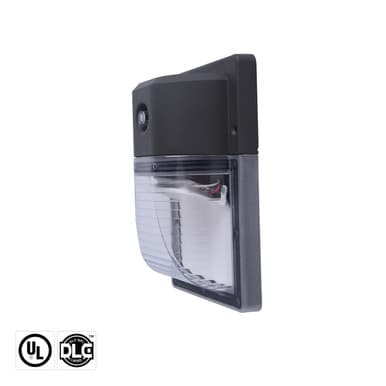
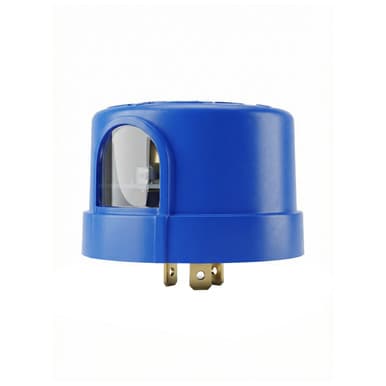
Recommended Products for Retail Parking
DLC Premium certified, full cutoff, IP65–IP66 rated area lights for shopping centers and retail facilities


LED vs Traditional: Energy Savings Comparison
Replacing 400W metal halide fixtures (458W actual) with 200W LED area lights
Actual wattage
Annual energy (13hr/day)
Annual cost ($0.12/kWh)
Lamp life
Maintenance (5-year)
100-fixture mall annual savings
DLC Premium certification qualifies for utility rebates of $30–$100 per fixture, further reducing payback to 1–2 years.
Case Study
500-Space Shopping Center LED Retrofit — Phoenix, AZ
A 500,000 sq ft regional shopping center in Phoenix replaced 96 × 400W metal halide fixtures with OT Series 200W LED area lights and OT02 150W units at entrances. The 5000K output improved security camera clarity significantly. After-hours 50% dimming via photocell controls reduced overnight energy costs. Utility rebates of $60/fixture covered $5,760 of upfront costs.
$18,000
Annual Energy Savings
2.4 yr
Payback Period
56%
Energy Reduction
Ready to upgrade your retail parking lighting?
Get a free photometric layout, IES RP-20 compliance review, and energy savings analysis for your shopping center.