Municipal, School & Church
Parking Lighting Guide
DLC Premium certified LED lighting with utility rebates — designed for budget-conscious community facilities
66%
Energy Savings
$30–$100
Rebate / Fixture
Free
Photometric Design
IES RP-20 Municipal Parking Illuminance Standards
Recommended foot-candle levels for government, school, church, and community facility parking
General municipal parking — low activity
Standard government and civic lots
School / campus parking
Safe for student and faculty
Church & community events
Higher during evening events
Entrances & crosswalks
Pedestrian safety priority
ADA accessible spaces
Required — all public facilities
Transit / bus stop areas
Rider safety at night
Park & recreation areas
Minimal — event-driven use
Source: IES RP-20 (Lighting for Parking Facilities). ADA Title II applies to all government facilities. Verify local dark sky ordinances before specifying CCT.
💰DLC Premium = Rebate Eligibility: Most utility rebate programs require DLC Premium listing. The average rebate of $60/fixture on a 20-fixture church or school lot reduces project cost by $1,200 — often cutting payback from 3 years to under 18 months.
Pole Height, Spacing & Wattage Selection Guide
Municipal and community parking lots favor moderate poles — community-appropriate appearance with code compliance
15–20 ft
20–25 ft
25–30 ft
30 ft max
Light Distribution: Type III vs Type V for Municipal
Community settings are sensitive to light trespass — perimeter control is critical
Type III — Perimeter & Community Edges
Required at all perimeter poles in community settings — prevents light trespass onto neighbor properties and streets.
Type V — Interior & Quad Poles
Use for interior poles in larger lots where parking surrounds the fixture on all sides — maximizes uniformity.
Compliance & Special Requirements
Key regulatory requirements for municipal, school, and church parking lighting
DLC Premium (DesignLights)
Required to qualify for utility rebates of $30–$100/fixture
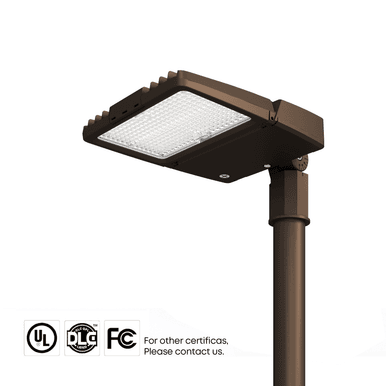
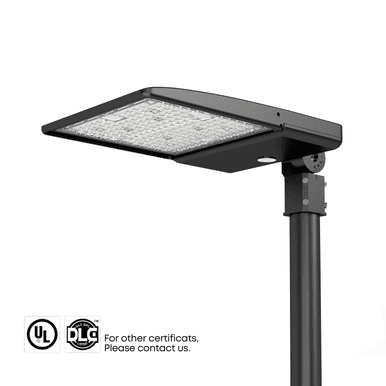
PLB Series and OT02 Series DLC Premium listed ✅
State procurement / Buy America
Many government projects require domestic sourcing
Verify with procurement officer before specifying
IES RP-20
1.0–2.0 fc for low-medium activity public parking
Standard design target for all public facilities
ADA Title II (government)
Minimum 2.0 fc, zero dark spots at all accessible spaces
Mandatory for all public-sector facilities
Dark sky / community sensitivity
Full cutoff + 4000K max CCT common in civic areas
Check local ordinance — especially near parks
ASHRAE 90.1 (new construction)
Photocell + 50% dimming capability required
Timer controls ideal for irregular-use facilities
Lighting Solutions by Municipal Scenario
Design parameters, example configurations, and recommended products for each municipal application
🏛️ City Hall, Courthouse & Library
Municipal buildings are the face of local government — lighting must be professional, welcoming, and community-appropriate. Usage is highly predictable: 7 AM–6 PM weekdays with occasional evening council meetings. Programmable timer controls allow full brightness during business hours, 50% dimming after close, and complete shutoff at midnight. DLC Premium certification is essential for utility rebate qualification through most state and municipal energy programs.
Design Parameters
| Target illuminance | 1.0–2.0 fc avg |
| Entrances | 2.0–3.0 fc |
| Uniformity | 4:1 |
| Pole height | 20–25 ft |
| CCT | 4000K (professional, community-appropriate) |
| Controls | Timer + photocell (off at midnight) |
Example Configuration
Recommended Products


🏫 K-12 School & Parking Lot
School parking lots have dramatically different usage patterns than any commercial lot. Weekdays during the school year see two peaks: 7–8 AM (drop-off, staff) and 2–3 PM (pickup, buses). Evening events — football games, concerts, back-to-school nights — require full brightness until 10 PM. Summers and weekends are largely unused. Programmable timer controls with photocell override are essential for energy savings.
Design Parameters
| Target illuminance | 1.0–2.0 fc avg |
| Uniformity | 4:1 |
| Pole height | 20–25 ft |
| CCT | 4000K–5000K |
| Controls | Photocell + timer (event schedule override) |
| Summer mode | 50% overnight or off after 10 PM |
Example Configuration
Recommended Products

⛪ Church & Worship Facility Parking
Church parking lots are classic irregular-use applications — heavy Sunday mornings, Wednesday evenings for mid-week services, and variable special events (Christmas, Easter, funerals) throughout the year. The rest of the time the lot sits dark. Photocell + programmable timer is the ideal control strategy: 100% during services, 50% for 30 minutes after, off until dawn. DLC Premium rebates of $30–$100/fixture dramatically improve the ROI for budget-constrained congregations.
Design Parameters
| Target illuminance | 1.5–2.0 fc avg (during services) |
| Off-hours | 0 fc (off from midnight to dawn) |
| Uniformity | 3:1–4:1 |
| Pole height | 20–25 ft |
| CCT | 3000K–4000K (warm, welcoming) |
| Controls | Photocell + programmable timer |
Example Configuration
Recommended Products
🎓 University & College Campus Parking
University campuses have complex parking needs — commuter lots, event parking (stadiums, arenas), and residential lots for students living on campus. Usage varies dramatically by semester, day of week, and time of day. Multi-zone controls allow commuter lots to dim after 10 PM while event parking stays at 100% during games. LEED and sustainability goals are common targets for public universities.
Design Parameters
| Commuter lot | 1.0–1.5 fc avg (dim after 10 PM) |
| Resident student lot | 1.5–2.0 fc avg (dusk-to-dawn) |
| Event / stadium lot | 3.0–5.0 fc (event nights) |
| Pole height | 20–25 ft (commuter); 25–30 ft (events) |
| CCT | 4000K campus standard |
| Controls | Zone-based photocell + event timer |
Example Configuration
Recommended Products

🌳 Park, Recreation & Community Center
Parks and recreation parking lots are the most irregular-use application in the municipal category — usage depends entirely on events. A soccer field lot may be packed on Saturday morning and empty Monday. A community pool lot peaks in summer afternoons. Photocell-only control with low-wattage fixtures (75W–100W) provides the most cost-effective approach for these low-density, event-driven applications.
Design Parameters
| Target illuminance | 1.0 fc avg (sufficient for parks) |
| Min illuminance | 0.2 fc |
| Uniformity | 4:1 |
| Pole height | 15–20 ft (low-impact) |
| CCT | 3000K–4000K (dark sky sensitive) |
| Controls | Photocell (dusk-to-dawn) or timer with curfew |
Example Configuration
Recommended Products
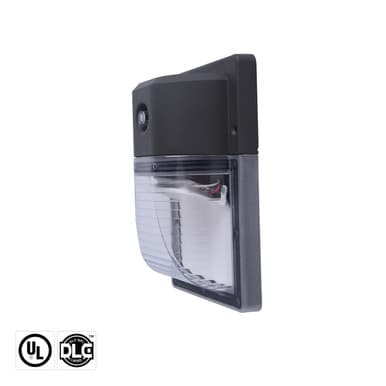
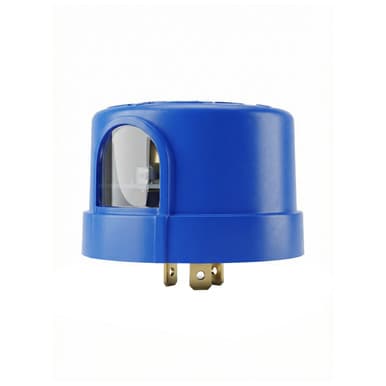
Recommended Products for Municipal Parking
DLC Premium certified LED area lights for schools, churches, city facilities, and parks — rebate eligible

LED vs Traditional: Energy Savings + Utility Rebates
Replacing 250W metal halide fixtures with 100W LED area lights — with DLC Premium rebate
Actual wattage
Annual energy (10hr/day)
Annual cost ($0.12/kWh)
DLC Premium rebate
Lamp life
20-fixture lot annual savings
Contact your local utility for current DLC Premium rebate amounts. Many state energy offices also offer additional grants for public-sector LED retrofits.
Case Study
Church + School Campus LED Retrofit — San Antonio, TX
A church-operated private school in San Antonio shared a 120-space parking lot between Sunday services and weekday school use. They replaced 16 × 250W metal halide fixtures with PLB Series 100W LED area lights. CPS Energy (San Antonio's utility) provided $80/fixture in DLC Premium rebates — $1,280 total. Programmable timers were set for school hours (7 AM–5 PM weekdays) and church services (8 AM–2 PM Sunday, 6–9 PM Wednesday). Overnight energy cost dropped to near zero.
$6,000
Annual Energy Savings
$4,800
Utility Rebates
1.4 yr
Payback Period
Ready to upgrade your municipal parking lighting?
Get a free photometric layout, DLC Premium rebate analysis, and energy savings calculation for your community facility.