LED Warehouse Lighting Guide
IES RP-7 High Bay Solutions
Complete design guide for warehouses, distribution centers, and fulfillment facilities — from IES RP-7-21 standards to fixture selection
70%
Energy Savings vs HID
150+
lm/W Efficacy
100K+
Hour Rated Life
IES RP-7-21 Warehouse Illuminance Standards
Recommended foot-candle levels by warehouse zone per IES RP-7-21 and OSHA requirements
Bulk Storage (Inactive)
Minimum for safe forklift navigation
Active Forklift Aisles
OSHA 1910.178 powered industrial truck requirement
General Open Storage
Includes vertical illuminance on rack faces
Picking & Packing Stations
High task complexity, barcode/SKU reading
E-Commerce Fulfillment
Small item identification, high-speed picking
Loading Docks
Indoor-outdoor transition zone
Quality Inspection Areas
CRI ≥ 80 recommended
Cold Storage
Compensate for frost/fog on optics
Office & Break Rooms
IES general office standards
Source: IES RP-7-21 (Industrial Facility Lighting), OSHA 1910.178. Always verify with local AHJ — municipal codes may impose stricter requirements.
💡Vertical illuminance matters. In racking environments, light on vertical rack faces is as important as horizontal floor light. Workers need to read labels, barcodes, and bin numbers at heights up to 40ft. Linear high bays aligned with aisle orientation dramatically improve vertical illuminance.
Mounting Height & Fixture Selection Guide
Match ceiling height to the right high bay type, wattage, and spacing
15–20 ft
Low-rise warehouses, mezzanine
20–25 ft
Standard warehouses ⭐
25–35 ft
Distribution centers, racking aisles
35–50 ft
Large DC, cross-dock facilities
Spacing-to-Mounting-Height Ratio (S/MH)
The key formula for uniform warehouse lighting layout
How S/MH Works
Spacing-to-Mounting-Height ratio determines how far apart fixtures should be relative to their mounting height above the work plane. A lower ratio means fixtures are closer together for more uniform light.
Quick Calculation Examples
Rule of thumb: fixture spacing = mounting height × S/MH ratio. Always verify with photometric software for actual layouts.
25ft ceiling, UFO (S/MH = 1.0)
Max spacing: 25ft × 1.0 = 25ft center-to-center
35ft ceiling, Linear (S/MH = 1.2)
Max spacing: 35ft × 1.2 = 42ft along aisle direction
45ft ceiling, Narrow beam (S/MH = 0.8)
Max spacing: 45ft × 0.8 = 36ft center-to-center
Compliance & Code Requirements
Key regulations for warehouse and distribution center lighting design
OSHA 1910.178
Adequate lighting for powered industrial trucks
Federal requirement for all warehouses
OSHA General Duty Clause
Safe working environment (29 USC 654)
Employer obligation
IES RP-7-21
Industrial facility lighting recommended practice
Industry benchmark for design
ASHRAE 90.1-2022
Occupancy sensors + daylight harvesting in warehouses
Energy code for new construction
California Title 24
Occupancy controls mandatory, 0-10V dimming
Required for CA facilities
DLC / DLC Premium
Utility rebate eligibility
$30–$100/fixture rebate potential
NEC / NFPA 70
UL 1598 listed fixtures
Electrical safety standard
NFPA 13 Sprinkler Clearance
18″ minimum below sprinkler deflector
Fire code for fixture mounting
⚠️NFPA 13 sprinkler clearance: All high bay fixtures must be mounted at least 18″ below the sprinkler deflector. Verify clearance during installation — violations can void fire insurance and trigger OSHA citations.
Lighting Solutions by Warehouse Type
Design parameters, example configurations, and recommended products for each warehouse application
📦 E-Commerce Fulfillment Center
E-commerce fulfillment demands the highest illuminance in warehouse environments. Workers pick thousands of small SKUs per hour, reading tiny barcodes and verifying items against handheld scanners. Poor lighting causes mispicks (costing $10–$30 per error), slows throughput, and increases injury risk. Shadows between racking bays hide labels and create tripping hazards in high-traffic pick paths.
Design Parameters
| Target illuminance | 50–75 fc |
| Min illuminance | 30 fc |
| Uniformity | 2:1 (avg:min) |
| Mounting height | 20–30 ft |
| CCT | 5000K (daylight white) |
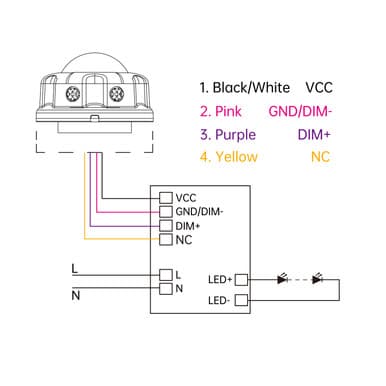
| Controls | Occupancy sensor + bi-level dimming |
Example Configuration
Recommended Products


🏭 3PL Distribution Center
Third-party logistics warehouses run multi-shift operations with 40–60ft rack systems and very narrow aisles (VNA). Turret trucks and order pickers operate at heights where vertical illuminance on rack labels is as critical as horizontal floor light. Linear high bays aligned with aisle orientation provide uniform vertical illumination that UFO fixtures cannot match in deep racking configurations.
Design Parameters
| Target illuminance | 30–50 fc |
| Min illuminance | 20 fc |
| Uniformity | 2:1 (avg:min) |
| Mounting height | 25–40 ft |
| CCT | 5000K |
| Controls | Aisle-based occupancy + daylight harvesting |
Example Configuration
Recommended Products


🧊 Cold Storage & Freezer
Cold storage environments (-40°F to 35°F) destroy conventional lighting — ballasts fail, plastic lenses crack, and condensation fogs optics within months. IP65 vapor tight fixtures rated for extreme temperatures are mandatory. Frost buildup on lenses reduces lumen output by 15–25%, requiring higher initial lumens to compensate. Workers in heavy PPE have reduced peripheral vision, making uniform lighting and bright vertical surfaces critical for safety.
Design Parameters
| Target illuminance | 15–25 fc |
| Min illuminance | 10 fc |
| Uniformity | 4:1 (avg:min) |
| Mounting height | 15–25 ft |
| Temperature rating | -40°F to 122°F |
| IP rating | IP65 minimum (vapor tight) |
Example Configuration
Recommended Products


🚛 Cross-Dock & Staging
Cross-dock facilities move freight directly from inbound to outbound trucks with minimal or no storage. The challenge is the extreme contrast between bright outdoor daylight at dock doors and the interior staging area. Workers constantly transition between 5,000+ fc sunlight and 20–30 fc interiors, causing dangerous visual adaptation delays. Dock bumper areas need enhanced lighting to prevent forklift collisions and load misidentification.
Design Parameters
| Target illuminance | 20–30 fc |
| Min illuminance | 10 fc |
| Uniformity | 3:1 (avg:min) |
| Mounting height | 20–30 ft |
| CCT | 5000K |
| Controls | Dock door sensors + photocell daylight response |
Example Configuration
Recommended Products

🏗️ Raw Material & Bulk Storage
Bulk storage warehouses have the lowest activity density but the largest floor areas — often 500,000+ sq ft with 24/7 lighting burning unnecessarily in empty zones. Forklifts traverse long aisles infrequently, making occupancy-based dimming the single biggest ROI opportunity. Motion sensor controls that drop fixtures to 20% power in unoccupied zones can cut energy use by 60% beyond the LED-vs-HID baseline savings.
Design Parameters
| Target illuminance | 5–10 fc |
| Min illuminance | 5 fc |
| Uniformity | 5:1 (avg:min) |
| Mounting height | 20–35 ft |
| CCT | 4000K–5000K |
| Controls | Motion sensor dimming (100%→20%) |
Example Configuration
Recommended Products

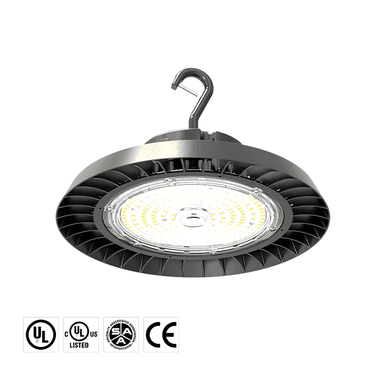
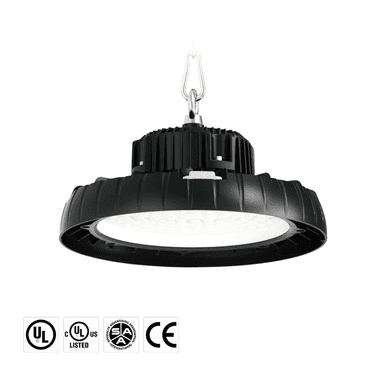
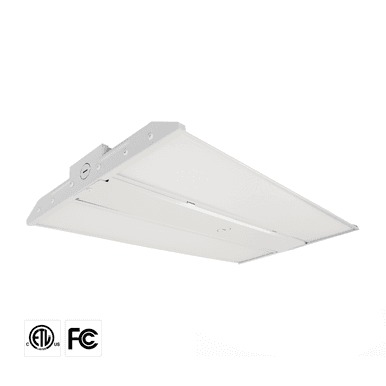
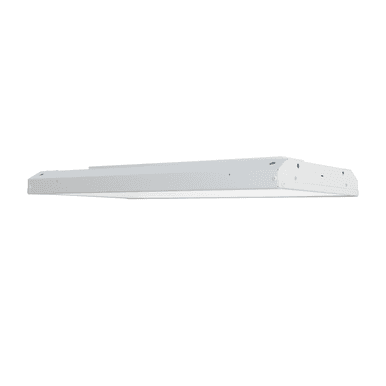
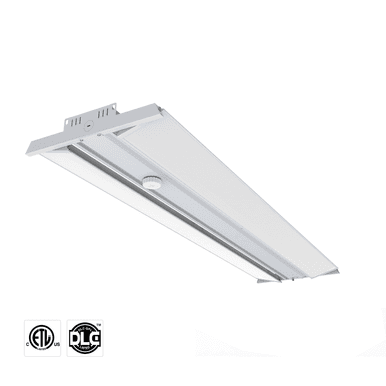
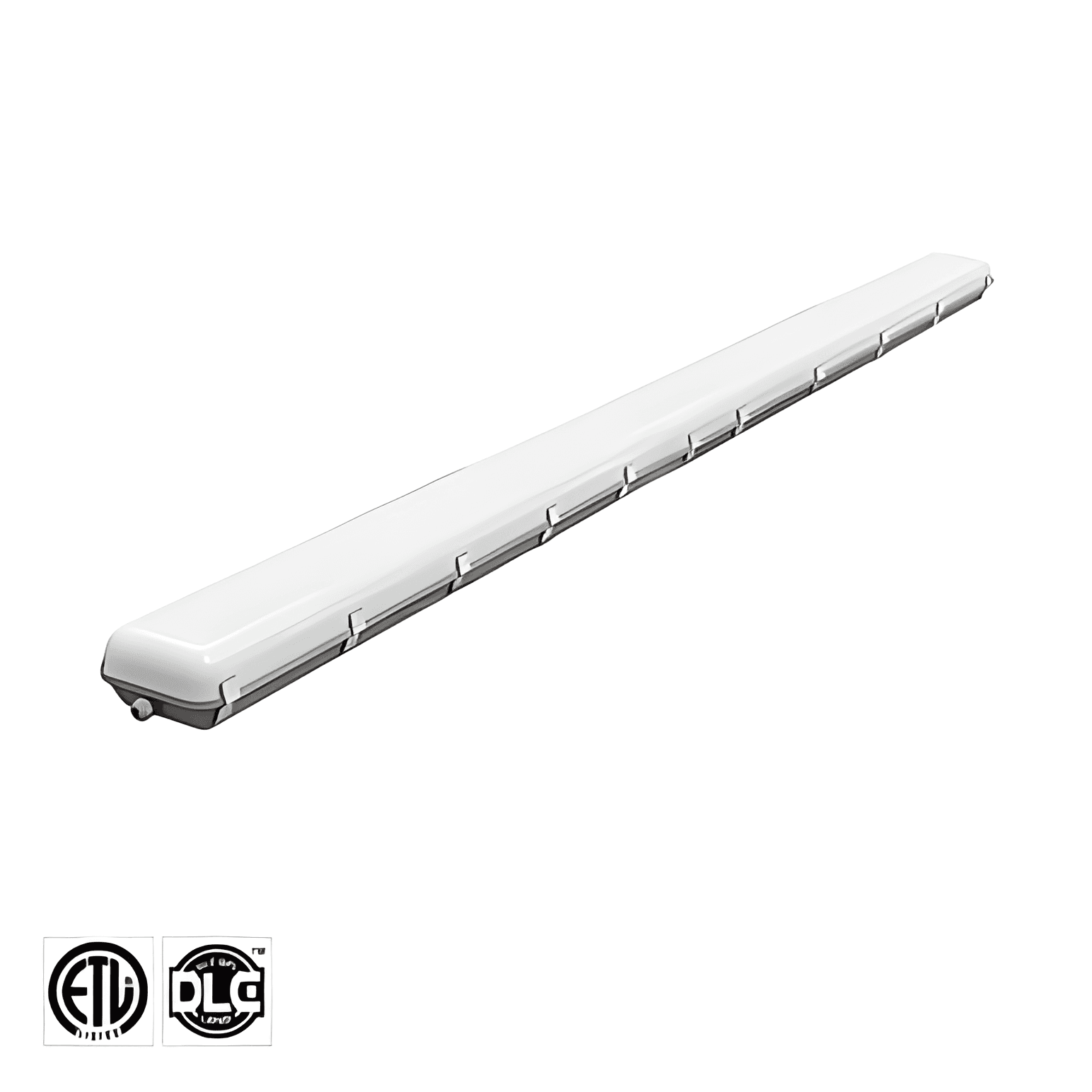
Recommended Products for Warehouse Lighting
DLC certified, IP65 rated high bays, linear fixtures, and accessories for warehouses and distribution centers
LED vs HID: Warehouse Energy Savings Comparison
Based on $0.12/kWh, 4,380 hrs/year (12 hrs/day × 365 days)
400W Metal Halide
250W Metal Halide
6-lamp T5HO
8ft T8 Fluorescent (4 lamp)
1000W Metal Halide
Add occupancy sensor controls for an additional 30–60% savings in low-traffic warehouse zones. DLC Premium certification qualifies for utility rebates of $30–$100 per fixture.
Case Study
200,000 sq ft Distribution Center — Ontario, CA
Replaced 180 × 400W metal halide with 180 × Auvolar 150W UFO High Bays (oH Series). Energy reduced 67%. SCE DLC rebates of $65/fixture covered 45% of material cost. Maintenance eliminated for 10+ years. Workers reported significantly improved visibility in racking aisles, reducing mispick rates by 22%.
$52,000
Annual Energy Savings
14 mo
Payback (after DLC rebates)
67%
Energy Reduction
Ready to upgrade your warehouse lighting?
Get a free photometric layout, IES RP-7 compliance review, and energy savings analysis for your warehouse or distribution center.