Port & Marine Terminal
Lighting Design Guide
IES RP-40 compliant high-mast LED lighting for container yards, docks, and cargo terminals
60–75%
Energy Savings
IP66
Marine Grade
100K+
Hour Lifespan
Select Your Terminal Zone
Jump to lighting requirements and product recommendations for each area
Container Stacking Yard
RTG/RMG crane operations, high-mast lighting
Truck Lanes & Gate Areas
Vehicle + pedestrian safety at entry/exit
Wharf & Berth Area
Ship-to-shore crane operations
Maintenance & Workshop
High-bay task lighting
Employee Parking & Admin
Standard parking lot lighting
Rail Yard & Intermodal
Track-side high-mast lighting
IES RP-40 Port Terminal Illuminance Standards
Recommended illuminance levels for port and marine terminal environments
Container stacking area
Truck lanes & internal roads
Gate/inspection area
Wharf/berth (ship loading)
Rail yard
Maintenance/workshop
Employee parking
Source: IES RP-40-19 (Lighting Port Terminals), OSHA 1926.56, IMO ISPS Code. Values are guidelines; verify with local port authority requirements.
🌊Marine environment demands: Salt spray corrosion (C3–C5 class), high wind loads (typhoon zones), IP66 minimum ingress protection, 10kV+ surge protection. All Auvolar OT & OT02 Series fixtures are IP66 rated with 20kV surge protection.
High-Mast Lighting Design Guide
The defining feature of container terminal lighting — mast heights, fixture counts, and coverage areas
18–25m (60–80ft)
25–35m (80–115ft)
35–45m (115–150ft)
💡High-mast LED retrofit tip: Most existing HPS/MH high-mast poles can support LED retrofits. A 1000W HPS fixture (26kg) can be replaced with a 600W LED (15–20kg) — lighter weight, less wind load, same or better output. Multiple beam angles per mast optimize uniformity.
Optics & Beam Angle Selection for High-Mast
Multiple beam angles per mast create the uniform coverage that single-angle fixtures cannot achieve
Narrow Beam
Far-end coverage. Projects light to areas beyond the mast perimeter — critical for covering the far edges of a container block from high mounting heights.
Medium Beam
General area coverage. The workhorse angle for most container yard zones — covers the mid-field between masts and fills in gaps between narrow and wide beams.
Wide Beam
Near-mast fill. Wide flood distribution illuminates the area directly below and around the mast base — prevents the dark-spot "hot top / dark base" effect common in single-angle high-mast designs.
Marine & Environmental Compliance
Standards and requirements for port lighting in marine environments
✅ IP66 Minimum Ingress Protection
Dust-tight and protected against powerful water jets — mandatory for salt spray corrosion in C3–C5 environments.
✅ IK10 Impact Rating
Resistant to 20J mechanical impacts — required for areas where crane cables, containers, or equipment may contact fixtures.
✅ 10kV / 20kV Surge Protection
Marine environments generate high electrical surges from equipment and lightning. 10kV minimum, 20kV recommended for high-mast.
✅ Marine-Grade Coating
Powder coating rated for marine environments (ISO 12944 C5-M class), stainless or hot-dip galvanized hardware.
✅ Wind Load Rating
High-mast poles in typhoon zones must be structurally rated. Fixture weight and drag coefficient factor into mast calculations.
✅ OSHA 1926.56 Illumination
Minimum illumination for construction and general industry — 5 fc for general construction areas, 3 fc for general walkways.
✅ IMO ISPS Code
International Maritime Organization ISPS Code requires sufficient perimeter lighting to detect unauthorized access via CCTV.
Lighting Solutions by Terminal Zone
Design parameters, example configurations, and recommended products for each area
📦 Container Stacking Yard
The core lighting challenge at any container terminal. RTG and RMG cranes require vertical illuminance on container faces for accurate twist-lock and lashing operations. High-mast poles at 25–35m are the norm, each carrying 6–8 LED fixtures arranged at multiple beam angles (narrow, medium, wide) to achieve uniform horizontal and vertical illuminance across the entire block.
Design Parameters
| Horizontal illuminance | 20–50 lux (2–5 fc) |
| Vertical illuminance | 10–20 lux |
| Uniformity | 3:1 |
| Mast height | 25–35m (80–115ft) |
| Fixtures/mast | 6–8 (mixed beam angles) |
| CCT | 5000K (maximum acuity) |
Example Configuration
Recommended Products


🚛 Truck Lanes & Gate Areas
Truck lanes and gate areas are high-risk zones where vehicles and pedestrians share confined spaces. Gate inspection requires 50–100 lux horizontal and 30–50 lux vertical for reading container numbers, documentation checks, and security inspections. Internal roads need consistent 10–20 lux for safe navigation around heavy equipment.
Design Parameters
| Gate/inspection | 50–100 lux (5–10 fc) |
| Truck lanes | 10–20 lux (1–2 fc) |
| Vertical illuminance | 30–50 lux (gate area) |
| Uniformity | 3:1 (gate), 4:1 (lanes) |
| Pole height | 10–15m (30–50ft) |
| CCT | 5000K (OCR camera-optimized) |
Example Configuration
Recommended Products
🚢 Wharf & Berth Area
Ship-to-shore crane operations at the wharf require sufficient vertical illuminance to illuminate container faces during loading and unloading. The combination of high ambient light levels at crane booms and ground-level operations creates unique photometric challenges. Marine exposure (salt spray, humidity) demands IP66 rated fixtures with anti-corrosion coatings.
Design Parameters
| Horizontal illuminance | 20–50 lux (2–5 fc) |
| Vertical illuminance | 10–30 lux |
| Uniformity | 3:1 |
| Mast height | 20–35m |
| IP rating | IP66 minimum (marine) |
| Surge protection | 20kV minimum |
Example Configuration
Recommended Products

🔧 Maintenance & Workshop Areas
Maintenance facilities demand the highest indoor/covered illuminance at ports — 200+ lux for detailed task work on heavy equipment, ship components, and cargo handling machinery. High-bay or mounted area lights provide uniform task lighting critical for safety when working with industrial tools and machinery.
Design Parameters
| Target illuminance | 200+ lux (20+ fc) |
| Uniformity | 2:1 (task-critical) |
| CRI | 70+ (tool and part identification) |
| Mounting height | 8–15m |
| CCT | 5000K (task visibility) |
| IP rating | IP65+ (dust and moisture) |
Example Configuration
Recommended Products
🅿️ Employee Parking & Admin Areas
Employee parking and administrative areas follow standard commercial parking lot practices at 10–20 lux. These zones typically operate shift schedules (6am–10pm) and benefit from photocell controls. Standard area light poles at 6–8m with 100W–200W fixtures provide cost-effective coverage that meets IES RP-20 parking standards.
Design Parameters
| Target illuminance | 10–20 lux (1–2 fc) |
| Uniformity | 4:1 |
| Pole height | 6–8m (20–25ft) |
| Spacing | 15–25m |
| CCT | 4000K–5000K |
| Controls | Photocell + overnight dimming |
Example Configuration
Recommended Products

🛤️ Rail Yard & Intermodal Facility
Rail yards and intermodal facilities are some of the most complex port lighting challenges — tracks, cranes, loaders, and workers operate in close proximity. High-mast lighting at 20–30m achieves the broad coverage needed across multiple tracks while minimizing pole count to avoid obstruction. 20–50 lux horizontal is needed for safe track-side navigation.
Design Parameters
| Horizontal illuminance | 20–50 lux (2–5 fc) |
| Vertical illuminance | 10–20 lux |
| Uniformity | 4:1 |
| Mast height | 20–30m |
| Spacing | 60–100m |
| CCT | 5000K |
Example Configuration
Recommended Products
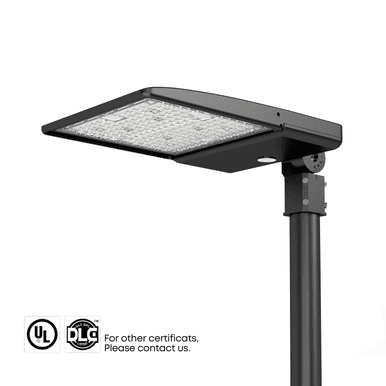
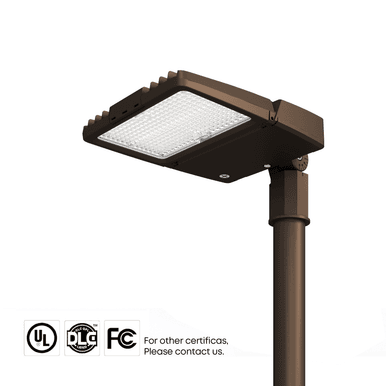
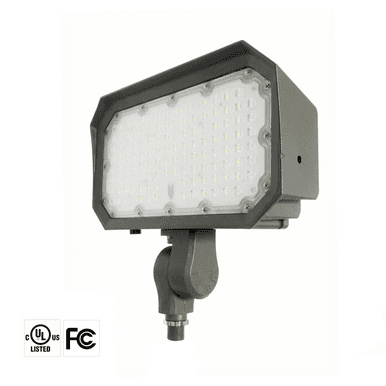
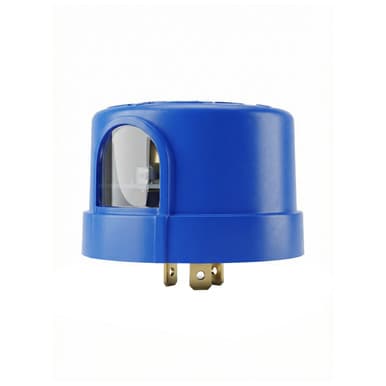
Recommended Products for Port Terminal Lighting
IP66 marine grade, high-output LED fixtures for container yards, wharfs, and all terminal zones

LED vs HPS: Energy Savings Comparison
Replacing 1000W HPS high-mast fixtures (1100W actual) with 400W LED
Actual wattage
Annual energy (16hr/day)
Annual cost ($0.12/kWh)
Lamp life
Re-lamping (high-mast crane)
20-fixture terminal savings
Note: High-mast re-lamping requires crane access costing $500–1,000 per event. LED eliminates this cost entirely for 10+ years.
Case Study
Regional Container Terminal — High-Mast LED Retrofit
A 12-block container terminal replaced 96 × 1000W HPS high-mast fixtures (8 per mast, 12 masts) with OT Series 600W LED fixtures. Horizontal illuminance improved from 18 lux to 32 lux average. Vertical illuminance on container faces improved from 6 lux to 14 lux — significantly better for crane operator visibility. 3:1 uniformity was achieved across all 12 blocks.
$47,100
Annual Energy Savings
2.8 yr
Payback Period
64%
Energy Reduction
Ready to upgrade your port terminal lighting?
Get a free high-mast photometric analysis, IES RP-40 compliance review, and energy savings projection.